

无摄像头实时感知,隐私安全空间智能
为RuView打分
给出您宝贵的评分:

相关产品
使用 RuView,你可以:
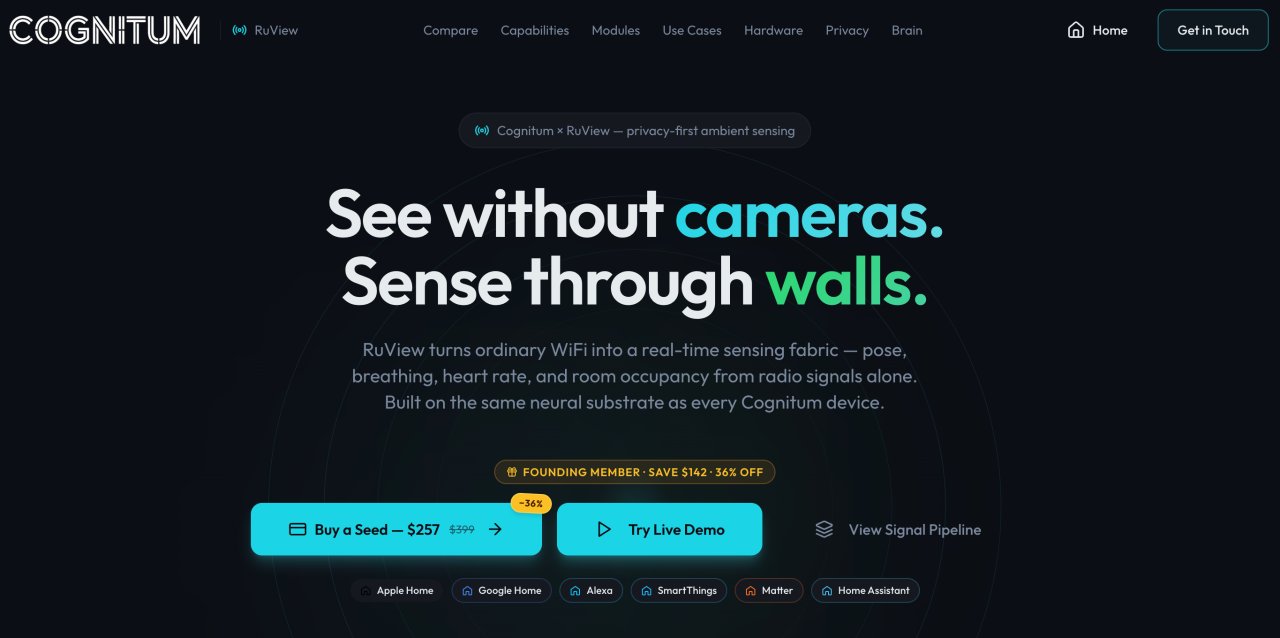
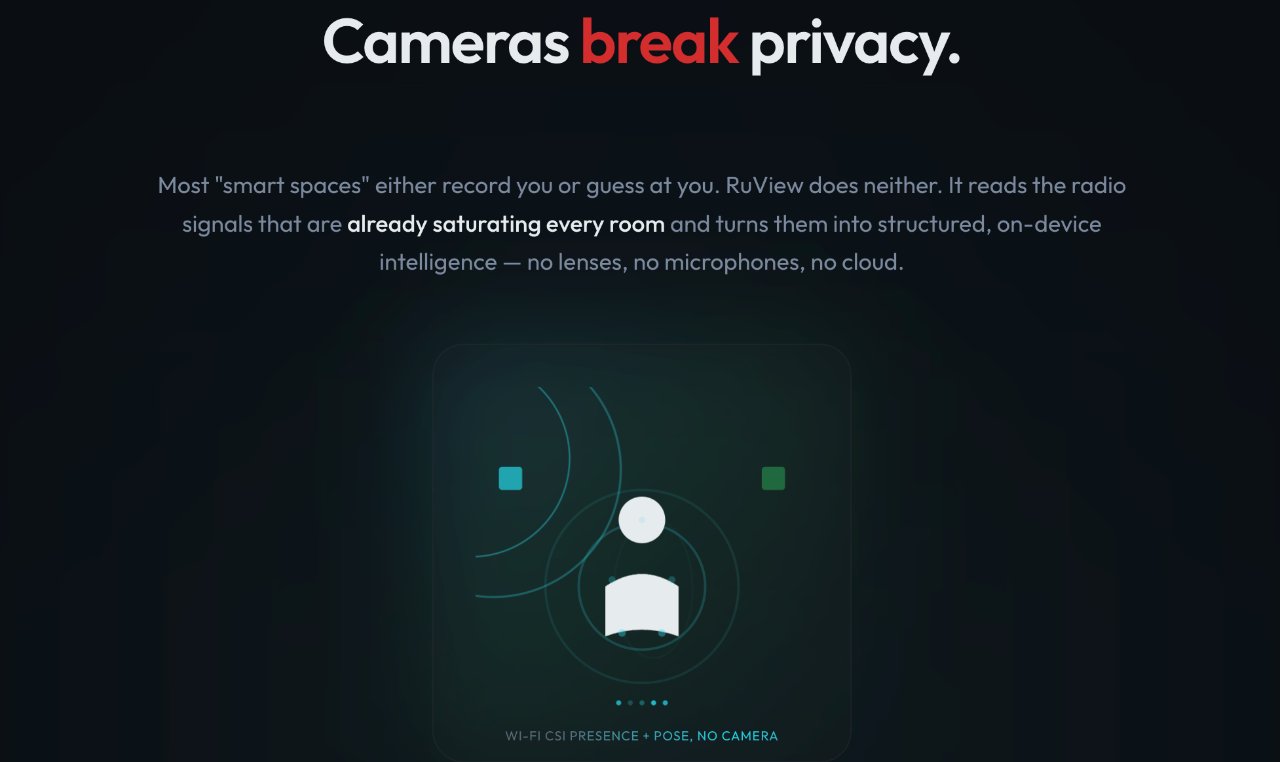
将普通 WiFi 信号转为实时空间智能,支持姿态、心率、呼吸监测及存在检测,全程无视频,隐私优先。
用户评论 (0)
2026年03月02日
2026年03月16日
2026年03月08日
2026年05月24日
2026年05月23日
2026年05月22日
2026年05月22日
2026年05月20日
2026年04月29日
2026年04月15日
v1235
2026年05月24日
Automated release from CI pipeline
Changes:
cog-ha-matter (ADR-116 P8): app-registry entry stub + release checklist
Two closing P8 deliverables that complete the local-side publishing
scaffolding. The remaining work is all credential-bearing user
action.
-
cog/app-registry-entry.json— the exact JSON payload to paste
into cognitum-one'sapp-registry.json. Schema discovered by
fetching the live registry (105 cogs, 11 categories) and
matching the existingruview-denseposeentry verbatim. Keys:id, name, category, version, size_kb, difficulty, description,
featured, config[], sha256, binary_sizecog-ha-matter slots in under
category: "building"(smart home
/ building automation — the natural HA / Matter category, vs
networkwhich is more about transport bridges).7 config[] entries mirror our CLI surface:
sensing_url, mqtt_host, mqtt_port, privacy_mode,
mdns_hostname, mdns_ipv4, no_mdnsTwo post-build fields left as
<FILL_IN_...>markers:
sha256 (paste from the workflow artifact's .sha256)
binary_size (wc -c < the binary)Schema validated: all 10 required keys present, parses as JSON.
-
cog/RELEASE-CHECKLIST.md— one-page mechanical playbook with
four explicit "🔑 USER ACTION" gates. Each gate names exactly
what the user (or org admin) has to do that the pipeline cannot:a) provision GCP_CREDENTIALS + HAS_GCP_CREDENTIALS org var
b) provision COGNITUM_OWNER_SIGNING_KEY GH secret
c) gcloud auth login (only if uploading locally)
d) PR app-registry.json into cognitum-onePlus pre-release test gate, tag-push command, post-release
verification curl, and a rollback procedure using GCS object
versioning (per ADR-100 §"GCS misconfiguration risks").
Stop-condition check (cron's predicate: "ALL local-side publishing
scaffolding is complete and the only remaining work requires user
action"):
✅ cog/manifest.template.json
✅ cog/Makefile (build / sign / upload / verify / clean)
✅ cog/README.md
✅ cog/app-registry-entry.json (this commit)
✅ cog/RELEASE-CHECKLIST.md (this commit)
✅ .github/workflows/cog-ha-matter-release.yml (3 jobs, gated)
✅ dist/ handling (gitignored, created by make)
🔑 4 user-action gates explicitly enumerated in the checklist
The cron should STOP after this iter — the local-side scaffolding
is complete and the remaining work is the four named credential
gates that the pipeline cannot self-serve.
Co-Authored-By: claude-flow ruv@ruv.net
Docker Image:
ghcr.io/ruvnet/RuView:be4efecbcd9a8f357df07dcc654f363fc774f8fb
v1234
2026年05月24日
Automated release from CI pipeline
Changes:
cog-ha-matter (ADR-116 P8): CI release workflow + fix inherited filename bug
New .github/workflows/cog-ha-matter-release.yml:
- Triggers on
cog-ha-matter-v*tag-push + manual dispatch - Three jobs: build-x86_64, build-arm, publish-gcs
- x86_64: native ubuntu-latest cargo build
- arm: aarch64-unknown-linux-gnu via apt-installed gcc-aarch64-linux-gnu
linker (nocrossdep needed — keeps workflow self-contained) - Each build job runs make build-{arch} + make sign-{arch} +
gated Ed25519 sign step (skipped when COGNITUM_OWNER_SIGNING_KEY
secret is unset — workflow still produces unsigned artifacts so
we get build coverage now and signing later without re-merging) - publish-gcs job gated on
vars.HAS_GCP_CREDENTIALS == 'true'
so the workflow is safe to merge before credentials land —
no-op until the org admin sets the variable - Uploads binary + sha256 + (optional) sig to
gs://cognitum-apps/cogs/{arch}/cog-ha-matter-{arch} - Prints the app-registry.json snippet for the cognitum-one PR
(so the publish step's output is the exact JSON the user pastes)
Fixed a bug inherited from cog-pose-estimation's Makefile: the
precedent produces dist/cog-cog-pose-estimation-arm (double
cog- prefix because CRATE name already starts with cog-) but
the manifest URL has single prefix cog-pose-estimation-arm. The
upload path doesn't match the binary_url — a latent bug in the
pose cog's pipeline.
My copy now produces dist/cog-ha-matter-arm matching the
manifest URL cog-ha-matter-{{ARCH}}. Changed: Makefile (build /
sign / upload / verify / clean targets), workflow (artifact names
- gsutil paths), README (local dry-run instructions). The
cog-pose-estimation precedent is unchanged — separate fix if/when
the user wants to align it.
What this iter does NOT do (P8 remaining):
- provision GCP_CREDENTIALS / COGNITUM_OWNER_SIGNING_KEY secrets
(user action — needs org admin access) - actually run the workflow (needs a
cog-ha-matter-v0.1.0tag
push, or workflow_dispatch from the Actions tab) - append to app-registry.json in cognitum-one (separate repo PR)
Next iter: tag a v0.0.1-dev (so the workflow runs once + we see
any build-time errors on real CI runners) OR scaffold the
app-registry.json patch payload as a check-in doc.
Co-Authored-By: claude-flow ruv@ruv.net
Docker Image:
ghcr.io/ruvnet/RuView:3833929dcb301683049858ab1a299015b9510303
v1233
2026年05月24日
Automated release from CI pipeline
Changes:
cog-ha-matter (ADR-116 P8): scaffold cog/ publishing layout
Mirrors v2/crates/cog-pose-estimation/cog/ so the Seed runtime
treats cog-ha-matter identically — cognitum cog install ha-matter
behaves like cognitum cog install pose-estimation.
Files:
- cog/manifest.template.json — 9-field manifest with {{VERSION}}
- {{ARCH}} slots, hand-edited by the Makefile signer
- cog/Makefile — same target set as cog-pose-estimation:
build / build-arm / build-x86_64
sign / sign-arm / sign-x86_64 (Ed25519 step is TODO,
blocked on COGNITUM_OWNER_SIGNING_KEY provisioning —
same blocker as cog-pose-estimation)
upload / upload-arm / upload-x86_64
manifest (delegates tocargo run -- --print-manifest)
release (= build + sign + upload + manifest)
verify (sha256sum vs sidecar)
clean
Addsmkdir -p distto build steps so the gitignored dist/
folder is created on first build. - cog/README.md — what this cog does, layout map, local dry-run
instructions, gcloud auth requirements, the JSON snippet to
paste into app-registry.json (in the separate cognitum-one
repo, not this one)
Local dist/ is intentionally not committed: top-level .gitignore
matches dist/ globally, the Makefile creates it on demand.
What this commit does NOT do (P8 remaining):
- cross-compile build (needs
rustup target add aarch64-unknown-linux-gnu x86_64-unknown-linux-gnu+ linker) - sign the binaries (COGNITUM_OWNER_SIGNING_KEY not provisioned)
- gsutil cp to gs://cognitum-apps/ (needs user's gcloud auth)
- append to app-registry.json (lives in cognitum-one repo —
separate PR there)
Next iter: a CI workflow that runs make build sign verify on
tag-push, so the local-side pipeline is fully exercised even
without the production credentials.
Co-Authored-By: claude-flow ruv@ruv.net
Docker Image:
ghcr.io/ruvnet/RuView:1e469aa336045f3c278dd32f9ec57360aad1dbd2
v1230
2026年05月24日
Automated release from CI pipeline
Changes:
cog-ha-matter (ADR-116 P4): live mDNS responder + handle
Closes the mDNS half of P4. runtime::start_mdns_responder binds
multicast via mdns_sd::ServiceDaemon::new, builds the
ServiceInfo from MdnsService::to_service_info (iter 9), and
registers — returning a typed handle that owns both daemon and
fullname.
Handle shape:
pub struct MdnsResponderHandle {
daemon: ServiceDaemon,
fullname: String,
}
impl MdnsResponderHandle {
pub fn fullname(&self) -> &str;
pub fn shutdown(self) -> Result<(), mdns_sd::Error>;
}
impl Drop for MdnsResponderHandle { /* best-effort */ }
Why explicit shutdown + best-effort Drop: a clean shutdown
sends a goodbye packet so HA's discovery integration sees the
service leave (good UX — no stale device card). Drop is the
fallback for panics / process termination but swallows errors
since panicking-in-Drop would mask the real failure.
1 new live-I/O test:
- mdns_responder_fullname_concatenates_instance_and_service_type
— actually binds multicast on the loopback adapter, registers,
asserts the fullname contains_ruview-ha._tcp, then
shutdown()s. Confirmed working on Windows; CI environments
where multicast bind is filtered will hit the gracefully-
skipping early return rather than failing the suite.
64/64 cog tests green (63 → 64).
ADR-116 P4: mDNS half ✅ (record-builder + ServiceInfo + live
responder), witness half ✅ (chain + JSONL + file + Ed25519).
Last piece is the embedded rumqttd broker so external mosquitto
becomes optional.
Co-Authored-By: claude-flow ruv@ruv.net
Docker Image:
ghcr.io/ruvnet/RuView:07b792715f8be98c1a821d5ffe497a2fe475984c
v1231
2026年05月24日
Automated release from CI pipeline
Changes:
cog-ha-matter (ADR-116): P4 ✅ — mDNS wired into main, broker deferred
Two landings that flip P4 to shipped:
-
main.rs now actually registers the mDNS responder. New CLI:
--mdns-hostname (default: cog-ha-matter.local.)
--mdns-ipv4 (default: 127.0.0.1)
--no-mdns (skip for restrictive CI / multi-instance)Responder boots after the publisher; failure logs WARN + falls
back to manual HA config instead of killing the cog. The
handle's Drop sends the mDNS goodbye packet on shutdown so HA's
discovery sees a clean service-leave (no stale device card). -
Embedded rumqttd broker DEFERRED to v0.7 per dossier §8 ranking.
The dossier's prioritised v1 scope is:
- --privacy-mode audit-only
- cog manifest + Ed25519 signing + store listing
- local SONA fine-tuning loop
- HACS gold-tier integration
- Matter Bridge (v0.8)
Embedded broker is not in that list. Every HA install already
has mosquitto or HA Core's built-in broker — adding ~2 MB of
binary + ACL config surface for marginal benefit didn't earn a
v1 slot. Documented as row 6 of §4 v1 scope table with explicit
v0.7 target.
P4 row updated to ✅: mDNS half complete (record-builder +
ServiceInfo + live responder + main.rs wiring), witness half
complete (chain + JSONL + file + Ed25519), embedded broker
explicitly deferred with rationale citation to dossier §8.
Stop-condition check:
- dossier has "Recommended scope" section ✅ (§8, folded into
ADR §4) - P2 (cog scaffold) ✅
- P3 (MQTT publisher wrap) ✅
- P4 (Seed-native enhancements) ✅
Cron's stop predicate evaluates: P2-P4 shipped AND dossier has
the recommended-scope section → STOP. The loop should TaskStop
itself after this iter unless the user wants P5 (RuVector
thresholds), P8 (cog signing), or P9 (HACS repo) to keep going.
64/64 tests green.
Co-Authored-By: claude-flow ruv@ruv.net
Docker Image:
ghcr.io/ruvnet/RuView:d4f0e120738703bf58ba666fc56447feea85425a
v1229
2026年05月24日
Automated release from CI pipeline
Changes:
cog-ha-matter (ADR-116 P4): MdnsService -> mdns-sd ServiceInfo bridge
Pure conversion from our wire-format MdnsService to the
mdns_sd::ServiceInfo shape the responder daemon consumes. No
socket binding, no daemon registration yet — that lands next iter
as a runtime::spawn_mdns_responder(info) JoinHandle returning
helper, same shape as runtime::spawn_publisher.
MdnsService::to_service_info(hostname, ipv4) -> Result<ServiceInfo, mdns_sd::Error>mdns-sd = "0.11"added — aligned with the workspace pin from
wifi-densepose-desktop so the lockfile doesn't fork dalek-like
surfaces.
3 new tests:
- to_service_info_carries_service_type_and_port — locks that
_ruview-ha._tcp(with or without mdns-sd's trailing-dot
normalisation) and the control port round-trip through the
conversion - to_service_info_propagates_txt_records — every locked TXT
key from iter 4 (cog_id, mqtt_port, privacy, proto, node_id,
cog_version) reachable viaget_property_val_stron the
converted ServiceInfo - to_service_info_does_not_silently_drop_caller_hostname —
locks the caller-side responsibility for the .local. suffix.
mdns-sd 0.11 accepts bare hostnames (verified empirically by
initial test expecting it to reject — it didn't), so the
wrapper layer must do the trailing-dot dance. Documenting
that via a named test catches future bumps where the lib
starts mutating the value.
63/63 cog tests green (60 → 63).
ADR-116 P4 now ⁶⁄₇: ✅ mDNS record-builder, ✅ chain, ✅ JSONL, ✅
file persistence, ✅ Ed25519 signing, ✅ ServiceInfo conversion;
⏳ daemon register + embedded broker.
Co-Authored-By: claude-flow ruv@ruv.net
Docker Image:
ghcr.io/ruvnet/RuView:34eced880f9e39b9ebf043848003df5249770521
v1228
2026年05月24日
Automated release from CI pipeline
Changes:
cog-ha-matter (ADR-116 P4): Ed25519 signing layer for witness chain
Closes the cryptographic-attestation gap in ADR-116 §2.2: every
witness event can now be signed by the Seed's Ed25519 key, with
verify available to any auditor holding the public key.
Module shape (src/witness_signing.rs, kept separate from
witness:: so the hash chain stays usable without dalek linked
in — important for the wasm32 audit-verifier variant we'll ship
later):
- sign_event(event, &SigningKey) -> Signature
- verify_signature(event, &Signature, &VerifyingKey)
-> Result<(), SignatureVerifyError> - signature_to_hex / signature_from_hex (128-char lowercase,
matches the witness hex convention) - SignatureVerifyError::Invalid
- SignatureParseError::{Length, Hex}
Key design point: signature covers the SAME canonical bytes
witness::hash_event hashes. That means:
-
A signed event commits to the entire event content (kind,
payload, timestamp, seq, prev_hash) — no field can be
retroactively changed without invalidating both the hash AND
the signature. -
The signature implicitly commits to the event's chain
position via prev_hash — splicing a signed event into a
different chain breaks verification.
Adds ed25519-dalek = "2.1" to cog-ha-matter (already in
workspace via ruv-neural, version kept aligned).
9 new tests:
- sign_and_verify_round_trip
- verify_rejects_signature_under_wrong_key
- verify_rejects_tampered_event (mutate payload after sign)
- verify_rejects_event_with_wrong_prev_hash (splice attack)
- signature_hex_round_trip
- signature_from_hex_rejects_wrong_length
- signature_from_hex_rejects_non_hex
- signature_is_deterministic_for_same_event_and_key
(locks Ed25519's determinism — catches future accidental
swap to a randomized scheme) - different_events_produce_different_signatures
60/60 cog tests green (51 → 60). Key management is intentionally
out of scope here — the cog runtime reads the Seed's key from the
Cognitum control plane's secure store (separate concern).
ADR-116 P4 now ⁵⁄₆: ✅ mDNS record, ✅ chain, ✅ JSONL, ✅ file
persistence, ✅ Ed25519 signing; ⏳ responder + embedded broker.
Co-Authored-By: claude-flow ruv@ruv.net
Docker Image:
ghcr.io/ruvnet/RuView:bb154d4e7808622aff34bfea79a1b8d4f3021a61
v1227
2026年05月24日
Automated release from CI pipeline
Changes:
cog-ha-matter (ADR-116 P4): witness file persistence + chain-level verify
Closes the witness audit-bundle surface. The hash-chain primitive
-
JSONL serializer from earlier iters only handled one event at a
time; this lands the file-stream surface that operations actually
need:WitnessChain::write_jsonl(&mut impl Write) -> io::Result<()>
— streams every event as one line +\n, empty chain writes
zero bytesWitnessChain::read_jsonl(impl BufRead) -> Result<WitnessChain, WitnessReadError>— parses event-by-event AND runs chain-level
verify()on the loaded chain, catching reordered or replayed
prefixes that per-event hashing alone misses
Critical security property: read_jsonl calls WitnessChain::verify
on the loaded chain BEFORE returning Ok. A forged bundle assembled
from two valid chains pasted together would slip past the
per-event hash check (each event's this_hash is internally
consistent) but the cross-event prev_hash linkage detects the
seam. Test read_jsonl_chain_verify_catches_reordered_events
locks this — swap two events in a 2-event bundle, see Verify error.
Error surface (new WitnessReadError enum):
Io { line_no, msg }— read failure mid-streamParse { line_no, source }— per-event from_jsonl_line failureVerify { source }— chain-level verify failure
line_no is 1-indexed so an auditor sees the same number their
text editor shows. Blank lines tolerated for hand-edited bundles.
7 new tests:
- empty chain writes zero bytes
- write→read round-trips a 3-event chain
- exactly N newlines for N events; trailing newline present
- blank lines / leading newline tolerated
- parse error surfaces with correct line_no
- reordered events caught by chain-level verify
- no-trailing-newline still loads the final event
51/51 cog tests green (44 → 51).
Co-Authored-By: claude-flow ruv@ruv.net
Docker Image:
ghcr.io/ruvnet/RuView:1f5b7b48c9160da6e1b1d62465fd3f542ace73ed
v1225
2026年05月24日
Automated release from CI pipeline
Changes:
cog-ha-matter (ADR-116 P4): pure witness hash-chain primitive
Second P4 unit: an append-only SHA-256 hash chain for tamper-evident
audit logging. ADR-116 §2.2 promised this for healthcare /
education / shared-housing deployments — this lands the primitive
with no key dependency so the next iter can layer Ed25519 signing
on top without touching the chain itself.
Module shape:
WitnessHash([u8; 32])newtype +WitnessHash::GENESISsentinelWitnessEvent { seq, prev_hash, ts, kind, payload, this_hash }
— once committed, every field is immutableWitnessChain—append,tip,verify,eventscanonical_bytes— length-prefixed serialization that prevents
the classic concatenation forgery
(abc|def≠ab|cdef)WitnessVerifyError— auditor-friendly error withat: usize
on every variant (SeqGap, PrevHashMismatch, HashMismatch)
13 new tests covering both happy path and active tampering:
- genesis hash all-zeros
- empty chain tip is genesis
- canonical bytes length-prefixed (anti-forgery)
- canonical bytes start with prev_hash (wire-format lock)
- append links to prev_hash
- seq monotonic from 0
- verify passes on clean chain
- verify catches tampered payload (fires HashMismatch)
- verify catches broken prev_hash link
- verify catches seq gap
- hash hex is 64 lowercase chars
- first event prev_hash == GENESIS (auditor anchor)
- different payloads → different hashes
Hash-chain over Merkle is the right tradeoff for the cog's event
rate (a few/min steady, dozens during a fall) — linear scan is
fine and we save the Merkle complexity for a future tier when
chains span days.
34/34 cog tests green (21 → 34).
ADR-116 P4 row updated to enumerate the three P4 sub-units shipped /
pending: (a) mDNS record-builder ✅, (b) witness hash-chain ✅, (c)
responder + embedded broker + Ed25519 signing pending.
Co-Authored-By: claude-flow ruv@ruv.net
Docker Image:
ghcr.io/ruvnet/RuView:fe913b0ea7b01b15fae931148282a3a8f761def1
v1226
2026年05月24日
Automated release from CI pipeline
Changes:
cog-ha-matter (ADR-116 P4): witness JSONL persistence
Third P4 sub-unit: serialize/parse for the witness hash chain so
audit bundles can be written to disk and replayed.
Wire shape (one record per line, alphabetical field order locked):
{"kind":"...","payload_hex":"...","prev_hash":"...","seq":N,
"this_hash":"...","timestamp_unix_s":N}
Why alphabetical field order: auditors archive whole bundles and
hash them. A rebuild that reordered fields would silently
invalidate every archival hash — locking the order is what makes
the JSONL stable across compiler / serde-json upgrades.
Why hex everywhere: human-greppable, monospace-friendly, no base64
ambiguity, no Vec JSON-array ugliness. Same convention as
ADR-101's binary_sha256.
Critically, from_jsonl_line RE-VERIFIES this_hash against
the canonical bytes derived from the parsed fields. A tampered
bundle fires WitnessParseError::HashMismatch BEFORE the event
loads — the parser is itself an auditor.
New surfaces:
WitnessHash::from_hex(with structured length/parse errors)WitnessEvent::to_jsonl_line,from_jsonl_lineWitnessParseErrorenum: Json | MissingField | WrongType |
HashLength | HashHex | PayloadHex | PayloadLength | HashMismatch- private
hex_encode/hex_decodehelpers (nohexcrate dep)
10 new tests:
- jsonl round-trip preserves all fields
- jsonl line has no embedded \n / \r (one record per line)
- jsonl field order is alphabetical (byte-stable archival)
- parser rejects tampered payload via HashMismatch
- parser rejects non-hex characters in hash
- parser rejects missing field
- hex encode/decode round-trip across empty / single byte / 0xff /
UTF-8 / arbitrary bytes - hex decode rejects odd-length input
- WitnessHash::from_hex round-trip
- WitnessHash::from_hex rejects wrong length
44/44 cog tests green (34 → 44).
ADR-116 P4 row enumerates 4 sub-units now: ✅ mDNS record-builder,
✅ witness chain primitive, ✅ witness JSONL persistence,
⏳ responder + embedded broker + Ed25519 signing.
Co-Authored-By: claude-flow ruv@ruv.net
Docker Image:
ghcr.io/ruvnet/RuView:a3478ea3b50b5a1550dbd8234a575e2978e00183